Connecting the Dots · Part 5 of 6 · Addressing Interfaces Before They Become Costly Changes
Connecting the Dots – Part 5: Instrumentation Interfaces with Piping Engineering
Successful process plant engineering depends on effective coordination between Instrumentation and other engineering disciplines. As part of this technical article series, Connecting the Dots: Instrumentation Interfaces with Other Engineering Disciplines, Ryka Engineering Solutions explores critical engineering interfaces, common design and coordination challenges, their impact on project execution, and practical approaches to achieving integrated, efficient and reliable engineering solutions for process industries.
Introduction-
5. Instrumentation ↔ Piping: Addressing Interfaces Before They Become Costly Changes
Instrumentation and Piping form one of the major engineering interfaces, requiring frequent interactions and close coordination throughout the project lifecycle.
Instrumentation is often described as the senses of a process plant. Inline instruments and actuated valves are installed directly in pipelines, while other instruments require dedicated pipe nozzles for process connections.
If instrumentation requirements are not considered early, changes after piping material take-off (MTO) release for procurement can lead to rework, delays, and additional costs.
What Goes Wrong?
- Nozzle size and internal clearance: The nozzle internal diameter needs to accommodate the instrument’s insertion dimensions. Nozzle wall thickness, insulation thickness, and any internal coating also need to be considered to ensure adequate clearance and proper instrument installation. These requirements call for close coordination with Piping at an early stage to avoid installation issues and design rework.
- Incorrect nozzle size or rating: Process connection sizes for offline instruments (i.e process connection given on the pipe nozzles) and applicable flange ratings as per project specifications, need to be defined in the Instrumentation Design Basis and communicated to Piping at an early stage. Where project-specific, Piping -Instrumentation interface specifications are unavailable, these requirements shall be established and aligned between the disciplines. Instrument flange ratings may vary depending on the applicable pressure–temperature rating charts; therefore, timely coordination is essential to avoid piping design changes, rework, and delays.
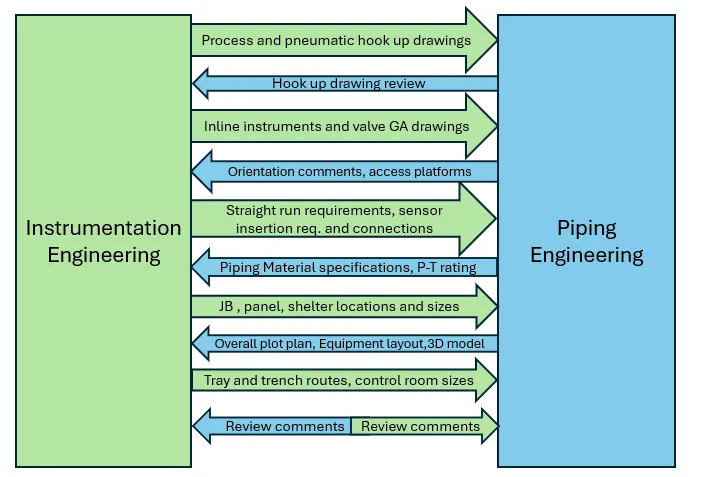
- Flow meter and control valve sizes: Finalized sizes, straight-run requirements shall be communicated to piping with mark-up on the latest P&IDs so that necessary reducers and spool lengths, routs can be taken care by piping.
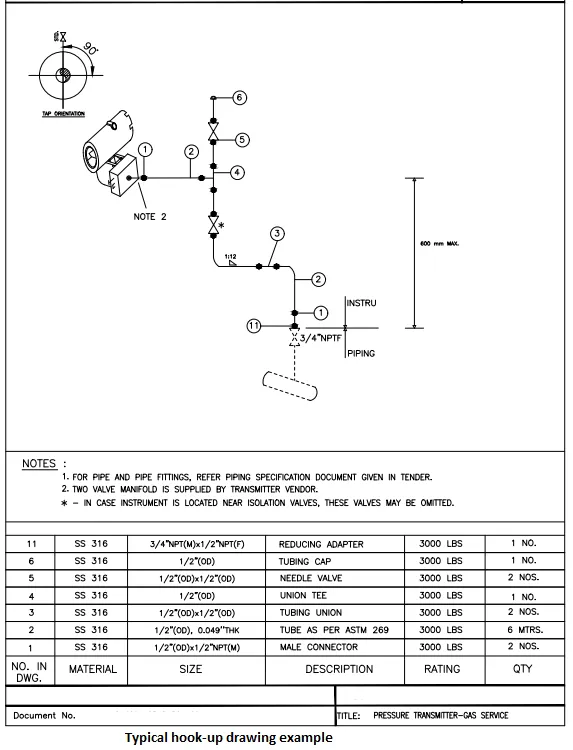
- Hook-up drawings and connections: Process connections for instruments and pneumatic connections for actuated valves shall be coordinated with piping once the relevant details are established.
- Analyzer schemes: Process sample connections, utility requirements and it’s connections, and any specific installation arrangements shall be communicated to piping in time.
- Missed instrumentation connections: If additional nozzles, tapping points, or straight-run lengths for instruments are identified late in the design stage, piping modifications may be required, leading to increased project costs and delays.
- Incorrect Instrument Orientation: Instrument and valve orientations requiring a specific display direction or maintenance access need to be identified and communicated to Piping through General Arrangement (GA) drawings at the appropriate stage. Without timely coordination, instrument readability and maintenance accessibility may be compromised.
- Pipe and Valve Material Specifications (PMS-VMS ): Piping and valve material specifications define requirements for valve type, materials, pipe schedules, connection sizes, bolting, gaskets, inspection, certification, and testing for a particular piping class and valve code. Instrumentation needs to comply all these requirements wherever applicable for their scope of instruments and valves. In the absence of these inputs, incorrect material selection may occur, and critical certification and testing requirements may be overlooked.
- Coordination of Cable Tray Routes and JB/Panel/Analyzer Shelter Locations: Main cable tray and trench routes finalized jointly with Electrical, along with junction box (JB) panel and shelter locations, need to be communicated to Piping in a timely manner. This enables Piping to allocate suitable tiers on the pipe rack for cable tray routing and identify appropriate locations for JBs ,panels and analyzer shelters as required, optimizing support structures and avoiding unnecessary duplication of tray supports.
- Timely Availability of Piping Inputs: Piping inputs, such as the overall plot plan, equipment layout, piping layouts, and 3D model (where applicable) showing instrument items, are essential for Instrumentation to develop instrument location layouts and cable tray layouts. These inputs need to be made available in a timely manner, in line with the project schedule, to avoid design delays and rework.
Why Does It Happen?
- PMS/VMS Not Available: In projects where OEM tender specifications are unavailable, Piping Material Specifications (PMS) and Valve Material Specifications (VMS) may also not be provided, creating ambiguity in material selection and applicable inspection and testing requirements.
- Premature Finalization of MTOs: Piping Material Take-Offs (MTOs) may be finalized and released before instrumentation datasheets and sizing details are finalized, potentially resulting in material discrepancies and rework.
- Delayed Sharing of Drawings and Design Inputs: Hook-up drawings and General Arrangement (GA) drawings of inline instruments and actuated valves, along with main cable routing requirements, need to be shared by Instrumentation with Piping. Similarly, the overall plot plan, equipment layout, and piping layouts showing instrument items need to be shared by Piping with Instrumentation. Delays in exchanging these inputs as per the project schedule can lead to design conflicts, rework, and installation issues.
- Late Communication of SIL/SIS, HAZOP Requirements: Additional connections required to meet Safety Instrumented System (SIS), hazop requirements may not be communicated to Piping at an early stage, resulting in piping modifications and delays.
Cost Impact
- Fabrication Rework: Adding nozzles or modifying connections may require additional welding, non-destructive testing (NDT), and engineering reassessment.
- Schedule Delays: Piping modifications can affect hydrotesting, painting, delivery, and construction milestones.
- Field Modification Costs: Changes at site may require additional manpower, inspection, and reassessment of pressure-boundary integrity.
- Instrument Redesign: If piping modifications are not feasible, the instrument mounting arrangement may need to be redesigned, potentially affecting measurement performance and maintainability.
- Incorrect Material Selection: Non-compliance with the specified piping material requirements may lead to replacement of components, additional inspection and testing, and delays in procurement or installation.
How to Close the Gap
- Identify Critical Interfaces Early: Confirm instrument and valve sizes, process connections, nozzle orientation, thermowell insertion lengths, and straight-run requirements at an early stage.
- Align Deliverables with MTO Schedules: Plan the release of datasheets, sizing calculations, P&ID mark-ups, and hook-up drawings in line with piping design and procurement milestones. Share finalized information with the Piping discipline promptly to avoid delays in material take-off (MTO) preparation and procurement.
- Expedite Vendor Data: Identify and track vendor information that may affect piping dimensions, material selection, and installation arrangements.
- Review Before IFD: Check instrument clearances, accessibility, maintenance space, and potential interferences before drawings are issued for design or construction, as applicable.
- Finalize Material Specifications: Even when OEM tender specifications are unavailable, Process and Piping need to coordinate with the client to agree on and finalize the basic Piping Material Specifications (PMS) and Valve Material Specifications (VMS), ensuring that material selection and inspection and testing requirements are clearly defined.
Early coordination between instrumentation and piping prevents avoidable rework, protects project schedules, and reduces overall engineering costs.